
Des Moines Prenatal Massage: A Practice Built for Every Stage
Last Updated on 13 July, 2026
Twenty years into her practice, Linnsey Sires built the specialty massage studio she always wanted — and chose WellnessLiving over Mindbody to grow it.
A Specialist’s Studio in the Middle of Iowa
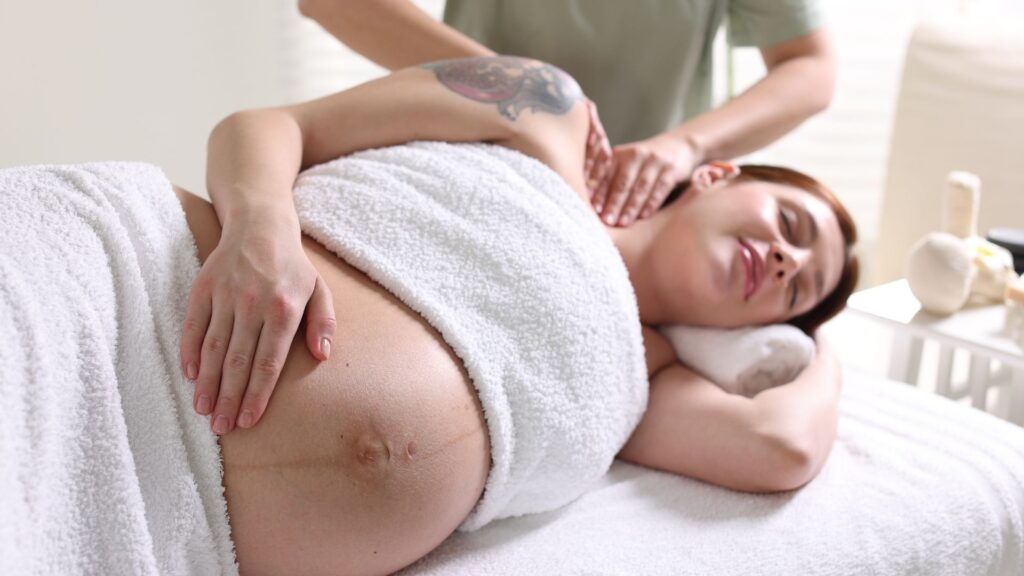
Linnsey Sires has been practicing massage therapy for two decades. Des Moines Prenatal Massage is the business she built around that expertise — a seven-year-old specialty practice in Iowa’s capital, focused entirely on a clientele most studios aren’t equipped to serve. Her tables are configured for pregnant bodies. The menu is written for trimesters. Her continuing-education workshops train other therapists in prenatal massage essentials.
It is, by design, a narrow practice. And it has become a busy one. By the time Linnsey began evaluating new software, her client roster had grown to more than 720 names, with roughly 200 actively booking. She had a part-time second therapist on contract, a son who wandered into her home office between school pickups, and a calendar booked weeks in advance.
“I’m so busy and so overwhelmed that I’m going to need to add an assistant, a front desk person — somebody to help me with the day-to-day. I need to find a system that is more all-in-one.”
She was also actively planning her next expansion: adding Pilates programming once she secures a larger space. The software she chose needed to support that future, not just the present.
A Practice Built Around Pregnant Clients
What separates Des Moines Prenatal Massage from a general wellness studio is the precision of its specialization. The menu is organized by life stage — prenatal, postpartum, and a maintenance option for clients who aren’t currently pregnant — and the pricing reflects a deliberate positioning choice.
The studio doesn’t sell add-ons. It sells expertise. “I just incorporate whatever people’s needs are,” Linnsey said. That precision creates an operational problem that a general booking flow can’t solve. Pregnant clients would book maintenance massages by accident, and Linnsey would have to call to sort it out.
“People are just booking maintenance massages and not prenatal massages, and then I’m having to call — like, I don’t know you, so I’m guessing you’re pregnant? And they’ll say, ‘Oh yeah, I’m like 300 weeks pregnant.’ Pregnant people, you know, they can have memory problems. It’s a confusing time.”
That observation — said with the affection of someone who has worked with thousands of expecting clients — was one of the central reasons she needed new software. A booking flow that let a 32-week pregnant client accidentally book the wrong service was a clinical problem, a scheduling problem, and a customer service problem at once.
What the Practice Offers
Des Moines Prenatal Massage operates Monday through Friday, with table sessions in 60-, 75-, 90-, and 105-minute formats across the prenatal, postpartum, and maintenance categories. Linnsey provides the majority of sessions herself, supported by a part-time therapist whose hospital nursing schedule shifts month to month.
Beyond the table work, the studio runs Yo Massage — a monthly group class combining yoga and massage, hosted in a rented space — and infant massage workshops taught quarterly for new and expecting parents. Prenatal Massage Essentials, a continuing-education course for licensed massage therapists, extends the studio’s reach into the professional community.
A small retail line rounds out the offering: jojoba oil, belly oil, electrolytes, muscle rub, and castor oil packs. Clients can purchase a five-session pack for table massages, and Linnsey honors gift cards, which she sells regularly. Pilates programming sits on the near-term roadmap, waiting on a larger physical space and likely accompanied by an on-demand video library for existing clients.
Why Linnsey Chose WellnessLiving Over Mindbody
Linnsey met with Mindbody before she met with WellnessLiving. The call didn’t go well — her three-year-old was loud throughout — but the price stuck with her, and so did the reputation. When WellnessLiving surfaced in her research, the comparison sharpened the decision.
She needed a system that integrated everything. Linnsey was running her booking software alongside a separate email platform and a separate payment system. “I had a booking software system, Mailchimp, and and Square for credit card processing. It blows my mind,” she said. “I cannot imagine trying to train somebody to follow all of that chaos.” WellnessLiving consolidated booking, payments, email marketing, automated campaigns, gift card sales, and reporting into one place.
She needed a booking flow that pregnant clients could actually navigate. Her existing setup let clients scroll past service categories and land on the wrong one. WellnessLiving’s customizable Book Now tabs let her separate prenatal, postpartum, and maintenance into clearly labeled paths, with descriptions and intake questions surfaced at the right moment.
She needed native functionality, not integrations. A key difference that emerged during her evaluation: Mindbody’s forms, waivers, and marketing tools are third-party integrations, while WellnessLiving builds them natively. For a practice that requires intake forms, medical histories, and signed policies before every new client engagement, that distinction mattered. “From what I’ve found, people are liking WellnessLiving more, and it’s a better price point. As somebody who’s growing my business, I’m much more comfortable with that.”
How WellnessLiving Fits the Operating Model
Three capabilities map directly to how the practice runs.
Service architecture organized by life stage. WellnessLiving’s Book Now tabs let Des Moines Prenatal Massage publish three clear paths — prenatal, postpartum, and maintenance — each with its own descriptions and color-coding on the staff schedule. When a prenatal client books, Linnsey sees that context before the session starts.
Intake forms and waivers built into the booking flow. The studio’s medical history intake and policies waiver are now configured to surface at the right moments — the waiver during account creation, the intake form before the first appointment. Custom questions like partner’s name and email run at booking for couples sessions, letting Linnsey set up a second client profile and send a fresh intake form without a phone call.
Automated client segmentation tied to retention. Client groups let the practice automatically tag clients by visit history. A prenatal client booked into a prenatal session can be grouped. Then that group can be targeted with postpartum messaging as timing changes. For a business serving a population whose needs shift over months, this replaces manual tracking with a system that updates itself.
What Linnsey Is Building
Des Moines Prenatal Massage is already specialized, busy, and trusted by a population that has few other places to go. More than 200 active clients. A calendar that books weeks ahead. A part-time therapist whose shifting schedule loads into the system one month at a time. A retail line that moves through the same checkout as the services.
The next chapter is already taking shape. A larger space is on the horizon. Pilates programming will follow. A video library will let existing massage clients begin Pilates at home before a dedicated studio is ready. “A video library might be a better option for me,” Linnsey said, “because I’ll ramble live for, like, days.”
What she needed was software that could carry all of it — the specialty practice she has spent seven years building and the expansion she is planning next. A system simple enough to hand off to a future assistant. A booking flow that works for pregnant clients. A platform that grows the way she intends to.
If you’re running a specialty massage, wellness, or fitness studio and finding that fragmented booking software, separate payment processors, and disconnected email tools are slowing you down — or if you’re comparing WellnessLiving to Mindbody for a growing practice — book free a demo to see how WellnessLiving fits your operational model.