
Choosing Between an Indoor Playground and Play Café: A Guide for Entrepreneurs
Both businesses serve the same audience — parents with young children — and both are growing. But choosing between an indoor playground vs a play cafe isn’t a branding decision. It’s an operational one, and getting it wrong is expensive.
The space you build shapes your costs, your staffing model, how customers behave once they walk in, how often they come back, and ultimately how you spend your days running it. Before committing to either model, you need to understand exactly what each one demands — not just what each one looks like.
This guide breaks down the real differences between an indoor playground vs play café, including startup costs with sourced figures, revenue models, customer behavior, operational tradeoffs, and the five questions you should answer before signing a lease.
- Key Takeaways: Indoor Playground vs Play Café
- What Is the Difference Between an Indoor Playground and a Play Café?
- Who Is Your Target Customer for an Indoor Playground vs Play Café?
- Startup Costs: Indoor Playground vs Play Café
- Revenue Models: How Each Business Actually Makes Money
- Operational Tradeoffs: What Each Model Actually Demands
- Marketing and Loyalty: Which Model Builds a Community Faster?
- Which Business Model Is Right for You? 5 Questions to Evaluate Before You Decide
- Managing Bookings, Memberships, and Operations with the Right Software
- Final Thoughts: Start with the Business Model, Not the Vision
- FAQs About Indoor Playground vs Play Café
Key Takeaways: Indoor Playground vs Play Café
| Category | Indoor Playground | Play Café |
|---|---|---|
| Primary Focus | Active physical play for children | Relaxed parent experience + child play area |
| What Drives the Visit | Burning energy, parties, special outings | Parent socializing, routine visits, convenience |
| Visit Duration | 1–3 hours | 1–2 hours |
| Visit Frequency | Occasional destination visits | Frequent repeat visits and community traffic |
| Typical Space | 3,000–10,000+ sq ft | 1,000–3,000 sq ft |
| Startup Costs | $150,000–$750,000+ | $80,000–$400,000+ |
| Equipment Costs | $30,000–$300,000+ (commercial structures) | $10,000–$50,000 (toddler-focused setups) |
| Biggest Revenue Driver | Birthday parties (can be 30–50% of revenue) | Repeat visits and ongoing F&B spend |
| Revenue Stability | Peaks on weekends and events; uneven midweek | Steadier daily flow from habitual visits |
| Staffing Model | More staff: supervision, parties, front desk | Smaller blended team: café service + childcare |
| Operational Complexity | Higher: safety compliance, party logistics | Lower day-to-day, but food service adds a layer |
| Loyalty Mechanism | Memberships, events, seasonal promotions | Daily routine, community, brand familiarity |
| Best For | Entrepreneurs comfortable with events and volume | Operators who enjoy hospitality and community |
| Core Software Needs | Party bookings, waivers, capacity, memberships | Memberships, family accounts, repeat communication |
What Is the Difference Between an Indoor Playground and a Play Café?
Both formats sit in the same market, but they’re solving different problems for their customers — and that distinction shapes everything downstream.
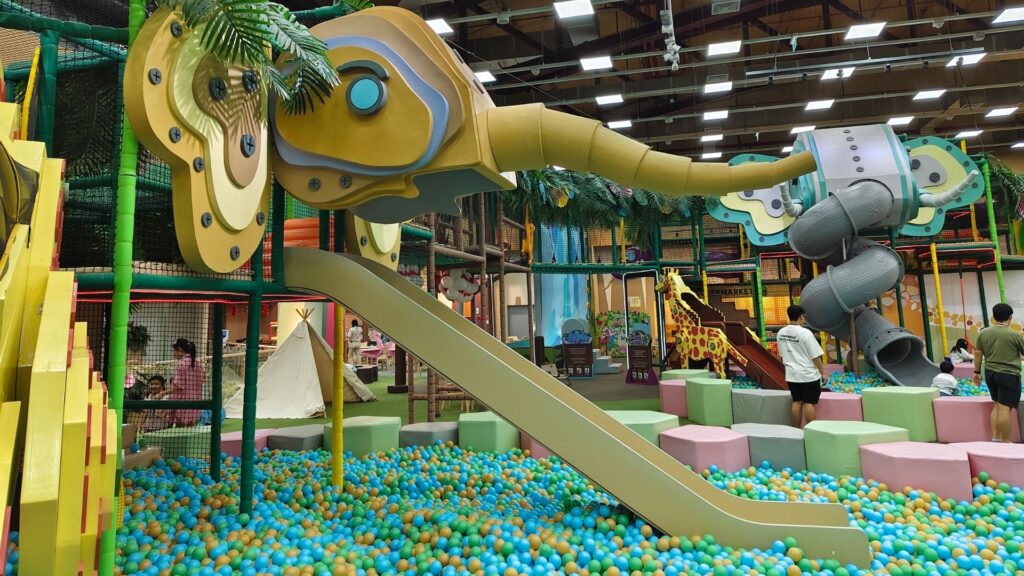
An indoor playground is built around physical activity. Climbing structures, slides, obstacle courses, and foam pits. Kids are the focal point. Parents supervise while children burn energy in a structured, high-activity environment. The business model is built around volume, capacity, and event packaging.
A play café is built around experience and convenience — for both parents and children. A smaller play area is paired with coffee, food, and comfortable seating. Parents are just as much the customers as the kids. The business model depends on those parents coming back regularly, spending on food and drink each time they do.
That core difference (what drives the visit) changes how you price, staff, schedule, and market. It also changes what kind of operator you need to be to run it well.
Who Is Your Target Customer for an Indoor Playground vs Play Café?
Most operators underestimate how much customer behavior differs between the two models. Both attract parents with young children, but the type of visit is fundamentally different, and your entire operation has to be designed around it.
| Factor | Indoor Playground Customer | Play Café Customer |
|---|---|---|
| Primary Motivation | Active play, energy release | Social time for parents + play for kids |
| Visit Duration | 1–3 hours | 1–2 hours |
| Spending Behavior | Upfront entry fee, occasional add-ons | Ongoing F&B spend + play fee per visit |
| Visit Frequency | Occasional — weekends, events, birthdays | Frequent — weekly or more, routine-driven |
| Children’s Ages | Wider range (toddler to 12+) | Mostly 1–6 years old |
| Group Size | Larger groups, parties, family outings | Small groups (parent + 1–2 kids) |
| Loyalty Drivers | Memberships, event quality, novelty | Familiarity, community, consistency |
Indoor playground operators need to drive volume through marketing, strong party bookings, and memberships. Play café operators need to become part of a parent’s weekly routine, which is harder to engineer quickly but more durable once established.
Pro tip: Before committing to either model, talk directly to parents in your target area. Ask about their actual behaviors — how far they’ll travel, what they’d pay, how often they’d come, and whether they’d pay a monthly membership. The answers often challenge initial assumptions.
Startup Costs: Indoor Playground vs Play Café
This is where the two models diverge most sharply and where operators most commonly underestimate the investment required.
Indoor Playground Startup Costs
According to SanXiu Playground’s 2025 US cost guide, opening an indoor playground in the US typically ranges from $150,000 to $750,000+, depending on size, location, and equipment scope. Here’s how that breaks down by cost category:
- Location and lease: You’ll need 3,000–10,000+ sq ft of commercial space. Rent in high-traffic urban areas can reach $20,000+/month for larger facilities. Suburban locations offer more manageable rates.
- Equipment: Commercial-grade playground structures typically range from $30,000 to $300,000+, depending on size, theming, and complexity. According to Hanlin Playground’s 2025 startup cost guide, equipment alone can range from $50,000 to $500,000 for larger, premium spaces.
- Build-out and safety: Safety surfacing, structural modifications, HVAC, and lighting can add $50,000–$150,000, depending on the condition of the space.
- Insurance and compliance: Higher premiums due to injury risk. Expect $2,000–$10,000 annually for liability coverage, plus inspections and licensing fees.
- Staffing: More staff required across supervision, party management, front desk, and cleaning — especially on peak weekends.
- Operating reserve: Budget at least 3–6 months of operating costs before you open. Monthly operating burn for a mid-sized facility can exceed $40,000 before revenue stabilizes.
Play Café Startup Costs
Play cafés have a more accessible entry point. According to WellnessLiving’s guide to opening a play café, startup costs typically range from $80,000 for a small basic concept to $400,000+ for a larger multi-zone facility, with the most variable costs being the café build-out and play equipment.
- Location and lease: Smaller footprint of 1,000–3,000 sq ft. More manageable rent, but premium locations in family-heavy neighborhoods still carry a high monthly cost.
- Play equipment: Simpler toddler-focused structures in the $10,000–$50,000 range. No commercial-grade multi-level builds required.
- Café build-out: This is where costs can surprise operators. Equipment, counters, plumbing, and seating can range from $20,000 to $100,000+, depending on how complex your menu and service model are. A simpler menu reduces both build-out and ongoing staffing costs.
- Food service licensing: You’ll need health permits, food handler certifications, and regular inspections on top of standard business licensing and child safety compliance.
- Staffing: Smaller team overall, but blended roles. Staff need to handle café service, maintain the play area, and support customers simultaneously.
Important reality check: Play cafés often look more affordable than they are. The café build-out and ongoing food costs add expense that pure play businesses don’t carry. Margins on F&B are typically thinner than on admissions, so consistent daily traffic isn’t optional — it’s the business model. Per businessplankit.com, ongoing monthly costs, including rent and payroll, typically consume 30–45% of revenue.
Revenue Models: How Each Business Actually Makes Money
Understanding how revenue is generated — and where it can break down — is one of the most important things to evaluate before choosing a model.
Indoor Playground Revenue Model
Typical revenue streams include:
- Entry fees (typically $10–$25 per child per visit)
- Memberships (monthly recurring revenue, often tied to unlimited weekday access)
- Birthday parties and private events
- Add-ons (snacks, merchandise, arcade games, themed experiences)
The critical thing to understand about the indoor playground revenue model: it is heavily peak-dependent. Industry data from Gitnux shows that party bookings generate 35% of yearly revenue for 70% of facilities. Other sources put the range higher: a 2025 analysis by Hanlin Playground found birthday parties and private events often contribute 30–50% of total revenue.
A few busy weekend party days can account for a large portion of weekly revenue. That’s powerful when occupancy is high — but it also creates real vulnerability. A slow party calendar, a competitor opening nearby, or an extended rainy season that paradoxically keeps people inside but not necessarily at your playground, can all meaningfully impact your numbers.
Memberships help stabilize this. Operators who actively push monthly membership programs tend to weather slow periods more reliably. According to Gitnux, membership programs boost revenue by 18% for participating venues.
Play Café Revenue Model
Typical revenue streams include:
- Coffee, drinks, and food (average ticket per adult often $8–$20)
- Play fees or minimum spend requirements
- Monthly memberships (often unlimited or discounted play access)
- Classes, workshops, or small events
- Retail (books, toys, small goods near checkout)
Play cafés operate on a fundamentally different financial logic. Individual transaction sizes are smaller than playground admissions, but the goal is higher visit frequency. The model only works if parents make your café part of their weekly routine.
This is what makes play cafés a close relative of what sociologist Ray Oldenburg called a “third place” — a gathering spot distinct from home and work that people return to habitually. When a play café achieves that status in a neighborhood, visit frequency and word-of-mouth become self-reinforcing. When it doesn’t, the thin margins on F&B leave little room to recover.
The operational implication: play cafés are harder to launch quickly and easier to run once established. Indoor playgrounds can generate faster initial revenue through party bookings, but require more active management over time.
Operational Tradeoffs: What Each Model Actually Demands
This is where business decisions turn into daily reality. The tradeoffs below aren’t reasons to avoid either model — they’re things you need to be honest with yourself about.
Indoor Playground: Where It Gets Hard
- Revenue concentrates on weekends. Midweek utilization is a persistent challenge — most operators use weekday group discounts, daycares, and school partnerships to fill capacity.
- Party management is operationally intense. Managing multiple simultaneous birthday events, staff coverage, setup/teardown, and customer experience under pressure requires solid systems and trained staff.
- Safety compliance is non-negotiable and ongoing. Equipment inspections, incident reporting, liability exposure, and maintaining certifications add meaningful time and cost.
- High fixed costs before you open. Equipment doesn’t generate revenue during installation, and lease obligations start from day one.
Play Café: Where It Gets Hard
- Food service is its own business. Managing a café kitchen — supply chains, food safety certifications, spoilage, and staffing — adds meaningful operational complexity that a pure play business doesn’t have.
- Margins are thinner than they appear. F&B margins are typically lower than play admission margins. Your profitability depends on volume and repeat visits, not high per-transaction revenue.
- Community takes time to build. The third-place dynamic that makes play cafés sticky doesn’t happen in the first month. Early-stage cash flow can be tight before the routine-visit flywheel starts turning.
- Menu decisions have downstream effects. A more complex menu requires more equipment, more staff training, and a larger kitchen footprint — which increases both startup cost and daily operational load.
Marketing and Loyalty: Which Model Builds a Community Faster?
Play cafés tend to build community loyalty faster once they reach critical mass, but indoor playgrounds can drive faster initial revenue. Here’s why the distinction matters.
Indoor playgrounds are largely destination-driven. Families come for a specific reason — a birthday, a rainy day, a special outing — and leave. Marketing for indoor playgrounds means keeping your brand top of mind for those moments, and actively converting visitors into members to increase return frequency. Without a membership push, many customers visit a few times per year.
Play cafés, when they work well, integrate into the parents’ weekly routine. Parents meet there regularly. Kids form attachments to the space and the other children they see there. The café becomes a default for weekday morning outings rather than a special event. That integration is the product — not just the coffee or the play structure.
The practical marketing implication: indoor playground marketing should prioritize events, memberships, and seasonal promotions. Play café marketing should prioritize community building, local SEO, and repeat-visit incentives — email and SMS campaigns, loyalty programs, and a strong local social media presence.
Both models benefit significantly from a robust customer communication system. Automated follow-ups after a first visit, birthday party reminders, class announcements, and membership renewal nudges all require software that connects your booking and communication tools in one place.
Which Business Model Is Right for You? 5 Questions to Evaluate Before You Decide
The most common mistake operators make is choosing a model based on what looks appealing — the branding, the aesthetic, the vision — rather than what actually fits their operational preferences and financial goals.
Answer these five questions honestly before committing:
| Question | What Your Answer Signals |
|---|---|
| 1. How do you want to make money? | Comfortable with high-volume peaks and event management → Playground. Prefer steady daily flow and lower variance → Play Café. |
| 2. Are you comfortable running food service? | If café management (kitchen, food safety, supply chain) feels like an added complexity you’d rather avoid, a playground is the cleaner model. |
| 3. Do you want to work weekends? | Indoor playgrounds peak on weekends and holidays. Play cafés distribute traffic more evenly across the week. Neither is ‘better’ — but be honest about your schedule. |
| 4. What’s your community role preference? | If you want to be embedded in the daily life of your neighborhood and build a community around your space, a play café fits that vision. If you prefer event-driven, higher-volume traffic, the playground suits you better. |
| 5. How much capital can you deploy, and when? | Playgrounds have higher upfront costs but can generate faster initial revenue through party bookings. Play cafés are cheaper to enter but take longer to reach the repeat-visit volume needed for profitability. |
Also worth asking: What are comparable businesses in your area already doing? A market with three established indoor playgrounds may have more whitespace for a well-positioned play café, and vice versa.
Managing Bookings, Memberships, and Operations with the Right Software
Once you’ve chosen your model, the operational question shifts quickly to: how do you keep everything organized without burning out your staff or yourself?
Both indoor playgrounds and play cafés share a common set of operational problems — managing admissions, handling birthday party bookings, running memberships, communicating with families — but the urgency of each problem differs by model.
For indoor playgrounds, the most critical operational needs are:
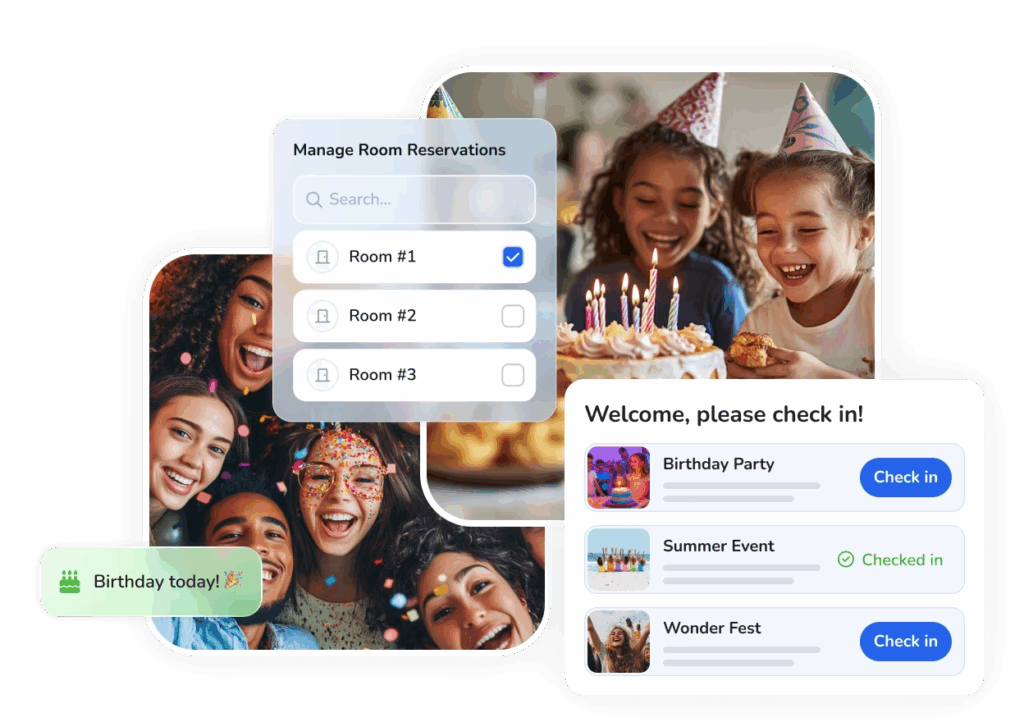
- Automated birthday party booking and deposit collection (your biggest revenue driver)
- Digital waivers and check-ins (reduces front desk friction at peak times)
- Capacity management (especially during busy weekend windows)
- Membership automation and recurring billing
- Staff scheduling across variable shift needs
For play cafés, the critical needs are slightly different:
- Family account management (parents booking and paying for multiple children)
- Recurring membership management and retention tracking
- Automated email and SMS communication to drive repeat visits
- Simple class and event booking for workshops or structured play sessions
- Integrated reviews and reputation tools to build local word-of-mouth
WellnessLiving’s software for play cafés and indoor playgrounds is built specifically for this market, which means it handles the operational workflows that matter rather than forcing you to adapt generic tools.
Key capabilities include:
- Family account management, so parents can book and pay for multiple children in one place
- Birthday party and event booking with automated deposits, reminders, and follow-ups
- Online waivers and digital check-in to reduce front desk bottlenecks
- Automated membership billing and recurring payment management
- Built-in marketing tools — email, SMS, and push notifications — to drive repeat visits without manual effort
- CAASI, an AI receptionist that handles incoming calls, captures leads, and books appointments 24/7, reducing the front desk load during busy periods
Running these functions through disconnected tools — a separate booking system, a different email platform, manual waivers — creates exactly the kind of operational friction that leads to missed bookings, slow check-ins, and inconsistent customer communication. A single platform eliminates that.
“WellnessLiving makes managing any business a breeze. The ease of use, custom app, and advanced marketing tools set it apart from other systems. I highly recommend it.”
— Michele Caruana, Play Cafe Academy
For a closer look at specific platform features, see: 8 benefits of playground/play café software that drive growth.
Final Thoughts: Start with the Business Model, Not the Vision
The idea of a space — the branding, the aesthetic, the atmosphere — is the easy part to fall in love with. The harder, more important work is deciding whether the underlying business model fits your goals, your capital, and the way you want to spend your time.
Indoor playgrounds offer higher revenue potential per event and can scale more dramatically, but require more capital, more staff, and more active management of peak-period logistics. Play cafés offer a more accessible entry point and a community-driven model — but they take longer to reach profitability and add the operational complexity of running a food service business.
Neither model is inherently better. The right answer depends entirely on your market, your capital position, and the kind of operator you want to be.
Start there. Everything else becomes easier to figure out from a firm foundation.
When you’re ready to evaluate the software that will run your day-to-day operations, book a free demo of WellnessLiving to see how it supports both indoor playgrounds and play cafés.
FAQs About Indoor Playground vs Play Café
Is a play café more profitable than an indoor playground?
Not automatically. Play cafés have lower startup costs and higher visit frequency, but smaller transaction sizes and thinner margins on food and beverage. Indoor playgrounds can generate higher revenue per event, especially through birthday party bookings. Profitability in both models depends on occupancy, membership retention, and operational efficiency — not the model alone.
How much does it cost to open an indoor playground or play café?
Indoor playgrounds in the US typically range from $150,000 to $750,000+ depending on size, equipment, and location (SanXiu Playground, 2025). Play cafés typically fall between $80,000 and $400,000+, with the café build-out being the most variable cost (WellnessLiving Play Café Guide).
What licenses and permits do I need to open a play café or indoor playground?
Both require standard business licensing, liability insurance, and local safety compliance approvals. Indoor playgrounds need commercial playground safety certifications and inspections. Play cafés additionally require food service permits, health inspections, and food handler certifications. Requirements vary significantly by state and municipality — confirm local regulations before signing a lease.
Which business is easier to manage day-to-day?
Play cafés are generally lower-complexity day-to-day, due to smaller spaces and fewer active supervision requirements. Indoor playgrounds require more ongoing management of safety compliance, staff supervision during peak periods, and party logistics. Play cafés add food service complexity, but the overall operational load is more evenly distributed across the week.
What software do indoor playgrounds and play cafés need?
Both models need booking management, membership automation, digital waivers, payment processing, and customer communication tools. Indoor playgrounds additionally need party booking workflows and capacity management. Play cafés need strong family account management and repeat-visit communication tools. Running these in a single integrated platform — rather than multiple disconnected tools — reduces operational friction significantly.
Can I run both an indoor playground and a play café in the same space?
Yes, and many successful operators do. Hybrid models combine a larger play area with a café component — capturing both the event revenue of a playground and the repeat-visit traffic of a café. The tradeoff is a higher startup cost and operational complexity, since you’re running two distinct business models simultaneously. Hybrid spaces tend to work best when the space is large enough to clearly separate the two zones, and when the operator has experience in both play management and food service.