
Your Guide to Opening a Play Cafe: Real Costs, Revenue, and Expert Advice
Last Updated on 11 June, 2026
A play cafe is one of the more compelling small business models for parents-turned-entrepreneurs: you solve a problem you personally feel, you serve a community you already know, and the concept is genuinely hard to replicate at home. But the gap between a well-run play cafe and one that struggles through its first two years almost always comes down to the same two things: underestimating how much the buildout actually costs, and launching without a recurring revenue model in place.
This guide covers both honestly. It’s written for operators in North America (with specific notes on Canadian licensing requirements where they differ) who are in the research and planning phase. You’ll find real cost ranges, a breakdown of revenue streams that actually move the needle, the mistakes that are easy to avoid once you know to look for them, and what to set up before your doors open — not after.
- What Is a Play Cafe — and Why Is the Model Growing?
- How Much Does It Cost to Open a Play Cafe in 2026?
- Full Startup Expense Breakdown for a Play Cafe Business Plan
- Play Cafe Revenue Streams: What Actually Drives Profitability
- What Equipment Does a Play Cafe Need?
- How Much Space Does a Play Cafe Need?
- Licences and Permits Required to Open a Play Cafe
- Independent Play Cafe vs. Franchise: Which Makes More Sense?
- The Most Common Mistakes When Opening a Play Cafe — and How to Avoid Them
- Play Cafe Launch Roadmap: 7 Steps to Opening Day
- FAQs About Opening a Play Cafe
What Is a Play Cafe — and Why Is the Model Growing?
A play cafe is a hybrid business: part supervised play space for young children, part cafe for the adults who bring them. One side of the business generates revenue through food and drinks; the other brings families in the door through play. The combination is intentional — parents get to relax with a coffee while kids burn energy in a safe, contained environment.
You’ll see the concept described a few different ways: kids cafe, indoor play cafe, kids play cafe. For practical purposes, they’re the same model. The defining feature is the coexistence of a staffed play zone and a food-and-beverage operation under one roof.
The broader market context is strong. The global family indoor entertainment market — the sector that includes play cafes, soft play centers, and family entertainment centers — was valued at approximately $26.7 billion in 2024 and is projected to grow at a CAGR of roughly 10% through 2034. Memberships and subscriptions are the fastest-growing revenue category in this market, which tracks with what operators on the ground are seeing: families want value, not just access.
The drivers behind play cafe growth aren’t hard to identify. More dual-income households mean less unstructured time for family activities. Urban density limits access to outdoor play. Parents with young children are an audience actively looking for reliable, weather-proof destinations that combine convenience with a decent cup of coffee.
How Much Does It Cost to Open a Play Cafe in 2026?
The honest answer: more than most first-time operators budget for. The ranges below reflect actual buildout and setup costs — not optimistic projections.
| Size | Estimated Startup Cost (USD) | What’s Typically Included |
|---|---|---|
| Small (1,000–2,000 sq ft) | $80,000–$150,000 | Basic soft play structure, espresso bar, limited seating |
| Mid-size (2,000–4,000 sq ft) | $150,000–$250,000 | Custom play zones, full café setup, party/event space |
| Large (4,000–8,000+ sq ft) | $250,000–$400,000+ | Multi-zone playground, commercial kitchen, dedicated event rooms |
The number that catches most operators off guard is buildout. If you’re taking on a raw retail space — or one that was previously a restaurant or retail store — electrical upgrades, plumbing modifications, HVAC adjustments, and structural changes can add $30,000 to $60,000 before a single piece of equipment arrives. Always get a contractor walkthrough before signing a lease, and build a 15–20% contingency buffer into your plan.
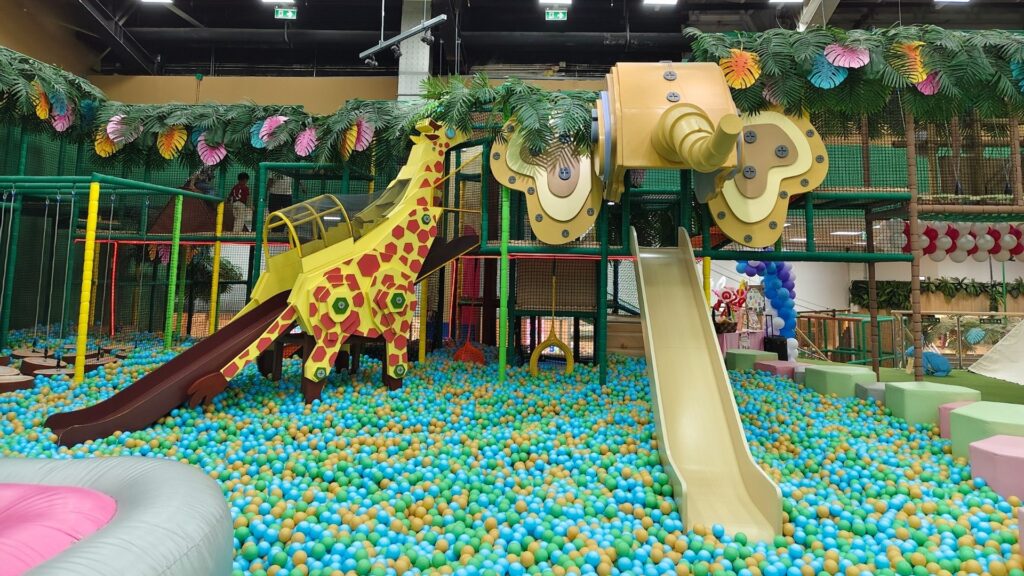
Play structures are the other major variable. Custom-designed play equipment costs significantly more than modular off-the-shelf options, but it’s also what makes a space visually distinct and Instagram-shareable — which matters for early marketing. If you’re on a tighter budget, a phased approach works: launch with modular equipment and reinvest into custom elements as revenue grows.
Full Startup Expense Breakdown for a Play Cafe Business Plan
A realistic business plan needs line-item estimates for every category — not just the big three. The table below reflects North American market pricing as of 2025-2026, with notes on where costs are most likely to surprise you.
| Expense Catagory | Typical Range | What to Watch For |
|---|---|---|
| Lease + deposit | $5,000–$20,000/month | Urban markets skew high; negotiate rent abatement during buildout |
| Renovation & buildout | $20,000–$120,000 | Electrical, plumbing, HVAC surprises add up fast |
| Play structures | $15,000–$150,000+ | Custom > modular in cost but also in differentiation |
| Café equipment | $10,000–$45,000 | Commercial espresso machine alone: $8,000–$20,000 |
| Safety flooring & compliance | $5,000–$20,000 | Non-negotiable; rubber/foam underlayment required |
| Furniture & seating | $5,000–$20,000 | Parent comfort drives dwell time and repeat visits |
| Permits, licences & insurance | $4,000–$15,000 | Varies significantly by province/state and city |
| Marketing (pre-launch) | $3,000–$15,000 | Local awareness matters more than paid ads in early months |
| Software & POS | $100–$400/month | Booking, memberships, payments — ideally one platform |
A few notes on budgeting approach: model conservative revenue for the first 6–12 months (assume 50–60% capacity utilization, not full). Separate your fixed costs from variable costs clearly — rent, insurance, and software are fixed; staffing, supplies, and food costs flex with volume. Know your break-even point before you open, not after.
Play Cafe Revenue Streams: What Actually Drives Profitability
The operators who reach profitability fastest aren’t the ones with the most foot traffic — they’re the ones who build predictable, recurring revenue alongside their walk-in business. Here’s what the revenue mix typically looks like, and why some streams matter more than others.
| Revenue Streat | Typical Range | Why It Matters |
|---|---|---|
| Drop-in play admission | $8–$18/child | Drives daily traffic, but varies with weather and season |
| Monthly memberships | $40–$90/family/month | Recurring revenue buffer; target 20%+ of revenue within 18 months |
| Birthday packages | $150–$400/party | Highest-margin bookings; $499 AOV is common for premium tiers |
| Café food & beverage | 40–60% of café revenue | Increases per-visit spend, especially high during parties |
| Workshops & classes | $15–$40/child/session | STEM, art, and music sessions drive midweek traffic |
| Private event hire | $200–$600/session | Low variable cost, strong margin if space is already built |
The Case for Memberships as an Anchor Revenue Stream
Drop-in admission is what most people think of as the core play cafe revenue model. It isn’t — or at least, it shouldn’t be. Drop-in revenue is weather-dependent, season-dependent, and entirely variable. A membership program converts that unpredictability into a stable monthly base.
A useful target: aim to have 20% of your total revenue coming from recurring membership fees within 18 months of launch. At 100 members paying $50/month, that’s $5,000 in predictable monthly income — often enough to cover rent. The mechanics matter: make membership easy to join, keep pause and cancellation policies clear, and automate billing so you’re not chasing payments manually.
Birthday Parties: The Highest-Margin Booking You Have
Birthday parties are where play cafes make real money. A well-structured party package — exclusive use of a zone, food included, a staff member coordinating — commands $150 to $400 per booking at minimum, with premium tiers reaching $499 or more per event. The variable cost per party is relatively low if your space is already built out and staffed. Add cafe sales during the party — operators report an additional $50–$100 per event — and birthday parties become a significant margin driver.
The strategic priority: fill your party calendar first. Word-of-mouth from a well-run birthday party is among the most reliable customer acquisition channels in this business. Parents talk, group chats move fast, and a three-month waitlist for Saturday party bookings is not uncommon for well-reviewed play cafes in medium-density markets.
What Equipment Does a Play Cafe Need?
You are effectively running two businesses under one roof, and each has its own equipment requirements.
Play Zone Equipment
- Soft play structures — climbing frames, slides, tunnels, ball pits
- Dedicated toddler zones with low-height, age-appropriate elements
- Safety flooring (rubber or foam underlayment — non-negotiable)
- Enclosed entry gates to contain young children
- Storage for rotating toys and loose play materials
- Sensory panels, activity walls, and themed role-play elements for differentiation
Cafe Equipment
- Commercial espresso machine and grinder ($8,000–$20,000 for quality equipment)
- Refrigeration units and under-counter storage
- Food prep surfaces and small appliances
- POS system and payment terminals
- Dishwashing setup scaled to your menu
The most common equipment mistake is overspending on aesthetics while underinvesting in durability. Play equipment in this environment takes heavy daily use from children — it will be climbed on, crashed into, and spilled on constantly. Commercial-grade materials and proper installation aren’t optional. Cheap structures that need replacing in 18 months are far more expensive than the right equipment bought once.
How Much Space Does a Play Cafe Need?
Space planning is where many first-time operators make costly mistakes. The goal isn’t maximum square footage — it’s the right layout for visibility, safety, and flow.
| Concept Type | Square Footage | Layout Notes |
|---|---|---|
| Small play cafe | 1,000–2,000 sq ft | Best for toddler-focused concept; limited event capacity |
| Mid-size | 2,000–4,000 sq ft | Room for age-separated zones + dedicated party space |
| Large indoor cafe | 4,000–8,000+ sq ft | Multi-zone play, commercial kitchen, separate event rooms |
Key layout principles that directly affect revenue: parents must have clear sightlines to all play zones from the cafe seating area — this is the difference between a 30-minute visit and a 90-minute visit. Toddler and older-child zones should be physically separated, both for safety and because mixed-age play makes parents of toddlers anxious. Stroller parking and easy access to bathrooms near the play zone aren’t amenities — they’re the reason families come back.
Zoning regulations and building codes govern occupancy limits, emergency exits, and safety requirements. In Canada, provincial building codes and municipal bylaws determine what’s permissible in your specific location. Building inspections and health authority approvals typically need to be factored into your pre-opening timeline.
Licences and Permits Required to Open a Play Cafe
Requirements vary by jurisdiction, but the categories below apply broadly across North American markets. Start this process earlier than you think you need to — approvals in most cities take longer than operators anticipate.
- Business registration — provincial/state and municipal registration required
- Food service licence — issued by your local health authority; triggers a health inspection
- Health inspections — for both food prep and the children’s play environment
- Liability insurance — essential; premises liability and commercial general liability at a minimum
- Fire safety approval — occupancy, exit signage, fire suppression systems
- Play equipment safety compliance — ASTM F1487 standards in the US; CSA Z614 in Canada
- Building permit for renovation — required for structural, electrical, or plumbing work
In Ontario specifically, play spaces that serve children must meet CSA Z614 playground safety guidelines, and food service operations are subject to Ontario Regulation 493/17 under the Health Protection and Promotion Act. Check with your local public health unit early — requirements vary by region, even within provinces.
Independent Play Cafe vs. Franchise: Which Makes More Sense?
This decision has the right answer for most people — it just depends on what you’re building and why. The table below lays out the tradeoffs clearly.
| Factor | Independant | Franchise |
|---|---|---|
| Startup cost | Lower upfront (no franchise fee) | Higher fees, typically $30,000–$60,000 on top of buildout |
| Brand recognition | None initially; must be built locally | Built-in awareness in established markets |
| Concept flexibility | Full control over design, menu, culture | Restricted by brand standards and guidelines |
| Operational support | Self-directed; learn as you go | Training, systems, and ongoing support provided |
| Ongoing fees | None beyond standard expenses | Royalties 4–8% of revenue + marketing contributions |
| Best fit for | Unique concept, community positioning | High-volume suburban markets, brand-dependent audiences |
The practical guidance: if your concept depends on community identity, a distinctive design, or a specific local niche (toddler-focused, sensory-inclusive, bilingual programming), go independent. Franchises impose brand standards that will constrain exactly the elements that would make your concept stand out. The support and systems they provide are real, but you’re also paying royalties on every dollar of revenue indefinitely.
If you’re entering a market where an established family entertainment brand already has strong recognition, and you want systems and training in place from day one, franchising can reduce the learning curve meaningfully. Just model the 4–8% ongoing royalty against your projected revenue — at $400,000 annual revenue, that’s $16,000–$32,000 per year going out the door before you reach profit.
The Most Common Mistakes When Opening a Play Cafe — and How to Avoid Them
1. Underestimating Buildout Costs
The equipment number is easy to research. The buildout number is not. Operators consistently report that structural modifications, electrical upgrades, HVAC work, and safety compliance requirements added 30–50% to their renovation budget over initial estimates. Get a general contractor to walk the space before you sign the lease. If they identify issues you didn’t know about, negotiate accordingly — or walk away.
2. Launching Without a Membership Program
Many operators launch with drop-in admission only and add memberships later. This creates a harder sell: you’re asking customers who are used to paying per visit to shift to a monthly commitment. Launching memberships from day one — even before you open, with pre-sale pricing — sets the expectation immediately and gives you a revenue base to open against.
3. Choosing the Wrong Location
Visibility and parking matter more for a play cafe than raw square footage or rent rate. A cheaper space that parents can’t easily find or park near will underperform a slightly more expensive space on a well-trafficked corridor. Proximity to residential density with young families, daycares, and elementary schools matters more than proximity to retail anchors.
4. Ignoring Safety Standards During Planning
Play equipment and safety flooring standards aren’t optional, and retrofitting compliance after the fact is expensive. Build ASTM (US) or CSA (Canada) compliance into your equipment spec from day one. Liability insurance underwriters will ask for it; health authorities will inspect for it.
5. Building Booking and Billing Systems Too Late
Operators who launch without a proper booking system — or who try to manage memberships and birthday party reservations through spreadsheets — hit a wall fast. The administrative burden of manual billing, cancellations, and waitlist management is significant even at a modest scale. Set up your booking and membership platform before you open, not in your third month when you’re already stretched.
Play Cafe Launch Roadmap: 7 Steps to Opening Day
| Phase | Step | What to Get Right |
|---|---|---|
| 1 — Validate | Research local demand | Talk to parents, run surveys, and check competitor density in your market |
| 2 — Plan | Define concept, audience, and pricing | Commit to a specific audience segment; don’t try to serve everyone |
| 3 — Secure | Location + funding | Negotiate rent abatement during buildout; model conservative revenue |
| 4 — Design | Layout + equipment order | Clear sightlines, separated age zones, and parent comfort built in |
| 5 — Comply | Permits, licences, insurance | Start this early; approvals take longer than expected in most cities |
| 6 — Build systems | Booking, billing, memberships | Set these up before you open — pre-sell memberships from day one |
| 7 — Launch | Soft open + events | Use a birthday party waitlist or free-play preview to generate early word of mouth |
One step operators consistently underinvest in: step 6. Setting up booking, billing, and membership systems before you open isn’t just administrative prep — it enables you to start selling memberships and birthday party slots before you’ve served a single coffee. Pre-opening revenue reduces the financial pressure of your first month and validates demand before you’re operational.
WellnessLiving’s play cafe software is designed specifically for this type of business — handling online booking, automated marketing, integrated payments, and a branded client app in a single platform. For operators building out their systems before opening, having scheduling, memberships, and billing unified from day one meaningfully reduces the administrative overhead that eats into time better spent on the floor.
Want to get a partner to handle the memberships, marketing, and other red tape? Book a free, no-commitment demo with WellnessLiving today and see how easy it can be!
FAQs About Opening a Play Cafe
How much does it cost to open a play cafe?
Startup costs typically range from $80,000 for a small, basic concept to $400,000+ for a large multi-zone facility. The most variable costs are buildout and play equipment. Budget a 15–20% contingency, and get a contractor assessment before signing a lease.
How long does it take for a play cafe to break even?
Most play cafes reach consistent profitability within 12–24 months, depending on startup costs and how quickly recurring revenue (memberships, party bookings) builds. Operators who launch a membership program from day one tend to reach break-even faster than those who rely on drop-in admission alone.
Is a play cafe a profitable business?
Yes, with the right revenue mix. Annual revenue potential ranges from $200,000 to $500,000+, depending on size and location, with multiple high-margin streams including birthday parties, memberships, and workshops. Profitability depends heavily on managing fixed costs and building a stable recurring revenue base — not just maximizing foot traffic.
What permits do I need to open a play cafe in Canada?
You’ll need business registration, a food service licence from your local health authority, a building permit for renovations, fire safety approval, and liability insurance. Play equipment must comply with CSA Z614 standards. Requirements vary by province and municipality — contact your local public health unit and municipal planning office early, as approvals take longer than most operators expect.
Should I open an independent play cafe or buy a franchise?
Independent is the better choice if your concept depends on local identity, a distinctive design, or a specific programming niche. Franchising can make sense if you want built-in systems and brand recognition, are entering a franchise-friendly suburban market, and are comfortable with 4–8% ongoing royalties. Run both scenarios through a 3-year financial model before deciding.
You could always build your own franchise instead.
What technology does a play cafe need to operate efficiently?
At minimum: an online booking system, a membership management platform, integrated payment processing, and automated communication tools for reminders and marketing. All-in-one platforms that handle scheduling, billing, and member management reduce the administrative burden significantly — especially for small teams. Setting these systems up before you open is strongly recommended.
Want to see how WellnessLiving has helped other play cafes succeed? Check out:
- WellnessLiving Selected as Software Provider for All Romp n’ Roll U.S. Locations
- How Confetti Play Place Built a Community Hub with AI Support
- Nani’s Playroom Switched Systems and Thrived with WellnessLiving